

Our Concern
Biodiversity Program – Saka Indonesia Pangkah Limited
Conservation Area
As a form of environmental commitment, PGN Saka through Saka Indonesia Pangkah Limited (SIPL) has designated the Banyuurip Mangrove Center (BMC) in Ujung Pangkah District, Gresik Regency, as a site for biodiversity conservation programs and research activities.

Saka Indonesia Pangkah Limited’s conservation efforts represent the company’s commitment to preserving and restoring ecosystem functions as well as protecting biodiversity (both flora and fauna). Since 2014, PGN Saka, together with several other stakeholders, has carried out mangrove restoration and expansion in the Ujungpangkah Subdistrict. The mangrove cluster in Ujung Pangkah—one of which is located in Banyuurip Village—has been designated as an Essential Ecosystem Area (KEE) by the East Java Provincial Government through Governor Decree No. 188/233/KPTS/013/2020, covering a total area of 1,554.27 hectares, with 127.61 hectares located within the administrative area of Banyuurip Village. This designation is followed by regulations regarding its management through East Java Governor Decree No. 188/122/KPTS/013/2021, in which Saka Indonesia Pangkah Limited is appointed as part of the management team in the field of conservation.
Biodiversity Development
Mangrove Vegetation Development
The mangrove ecosystem in BMC represents a naturally occurring secondary ecosystem that has experienced disturbances due to land conversion. The remaining mangrove stands are located along a one-kilometer stretch of brackish riverbanks extending to the coastal estuary. The disturbances and degradation that have occurred are still within the ecosystem’s resilience threshold, allowing the mangroves to retain their capacity to naturally recover toward their climax condition over a long period of time.
The dynamics of plant species composition in BMC and its surrounding areas are influenced by two factors: (i) natural factors, in which natural succession occurs alongside the adaptive capacity of each species, and (ii) human factors, such as planting activities carried out for species collection or enrichment purposes.
A comparison of mangrove vegetation in the BMC area is presented as follows:
Table. Comparison of Vegetation Monitoring Results at the BMC Site (2022–2025)
| No | Monitoring Results | 2022 | 2023 | 2024 | 2025 |
|---|---|---|---|---|---|
| 1 | Species Composition | 22 | 22 | 93 | 110 |
| 2 | Growth Habit Types | 4 | 4 | 5 | 5 |
| 3 | Families | 15 | 15 | 42 | 45 |
| 4 | Conservation Status | ||||
| • Government Regulation No. 7/1999 | – | – | – | – | |
| • Ministerial Regulation LHK No. P.106/2018 | – | – | – | – | |
| • CITES Appendices | – | – | – | – | |
| • IUCN Redlist | 15 | 15 | 49 | 63 | |
| 5 | Average Total Density | ||||
| • Trees | 2,466.67 (ind/ha) | 2,466.67 (ind/ha) | 2,400 (ind/ha) | 2,533.33 (ind/ha) | |
| • Poles (Saplings) | n.o.n.e | n.o.n.e | n.o.n.e | n.o.n.e | |
| • Seedlings | Nursery: 34,166.67 (ind/ha) Jogging Track: 10,000 (ind/ha) | Nursery: 35,833.33 (ind/ha) Jogging Track: 10,000 (ind/ha) | Nursery: 35,833.33 (ind/ha) Jogging Track: 10,000 (ind/ha) | Nursery: 36,250 (ind/ha) Jogging Track: 14,166.67 (ind/ha) | |
| • Understory Vegetation | n.o.n.e | n.o.n.e | n.o.n.e | n.o.n.e | |
| 6 | Average Total Dominance (trees) | 15.46 (m²/ha) | 25.84 (m²/ha) | 28.40 (m²/ha) | 29.06 (m²/ha) |
| 7 | Range of Species Diversity Index (H’) | 0 to 1.41 (low–moderate) | 0 to 1.41 (low–moderate) | 0 to 1.41 (low–moderate) | 0 to 1.41 (low–moderate) |
The coverage area for the plant species inventory conducted in 2025 was broader compared to previous monitoring periods. The survey area for plant species was expanded to include fishpond areas surrounding the BMC location. As a result, the number of species recorded increased. The analysis of the Flora Biodiversity Index (IKH) over the years continues to show that the IKH values remain relatively stable and consistent.
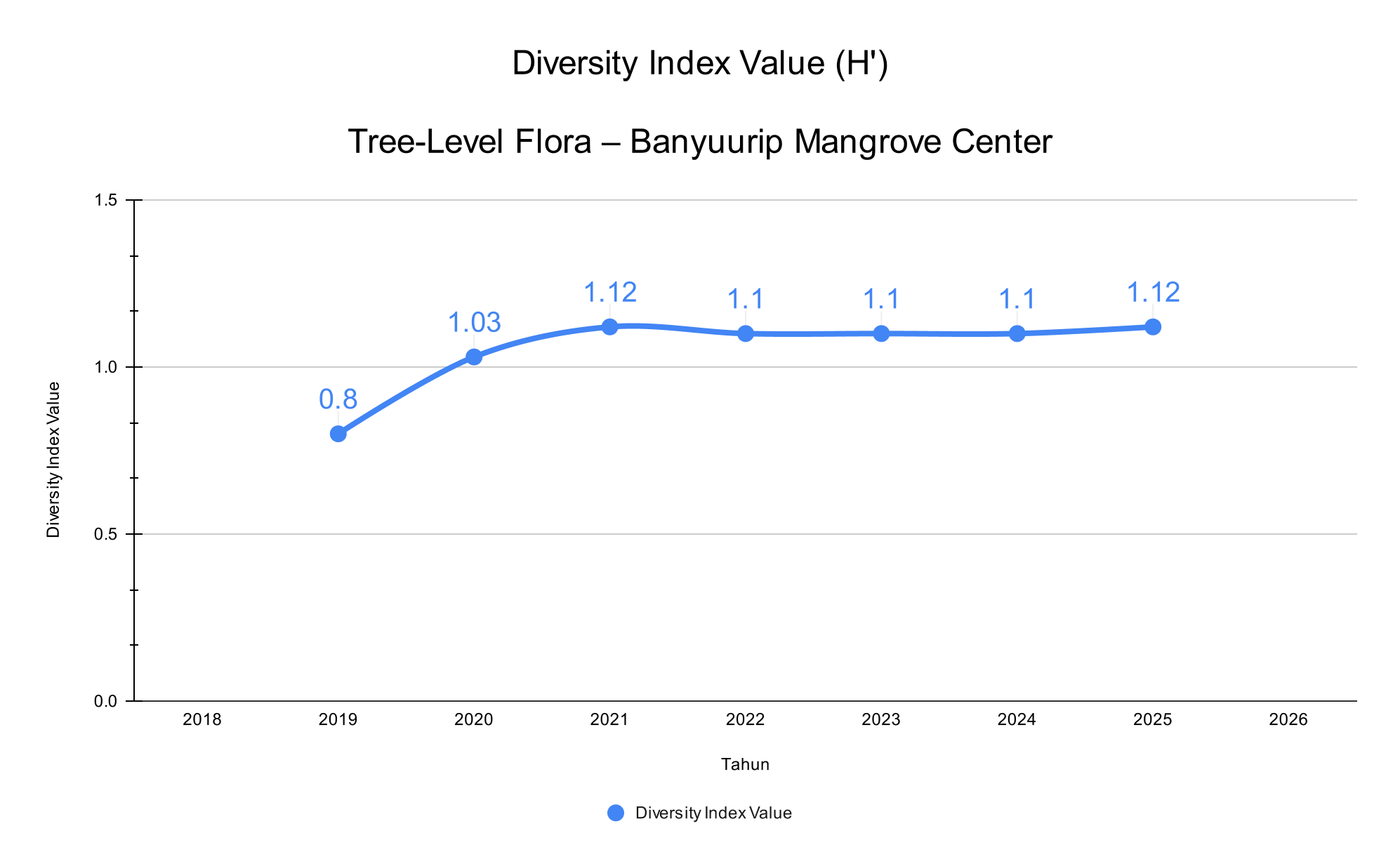
Figure. Floral Diversity Index (H’) at the Tree Level in the Banyuurip Mangrove Center Area from 2019 to 2025


Figure. Several Plant Species Found in the BMC Area
Fauna (Bird) Development
The fluctuation in wildlife sightings at BMC varies from year to year. This is influenced by seasonal factors and the mobile nature of wildlife species. However, the annual trend of sightings shows a progressive increase. The bird species composition is dominated by the family Ardeidae, a group of wading waterbirds with a wide dispersal capability. Waterbirds are defined as bird species that are ecologically dependent on wetland ecosystems. The landscape of BMC—consisting largely of mangroves and fishponds extending to the coastline—serves as a preferred habitat for most waterbird species.
Additional planting of mangrove species and/or coastal vegetation is considered effective in increasing food resources for wildlife (particularly birds), either directly (fruit, seeds, nectar) or indirectly (attracting insects, providing spawning grounds for fish and crustaceans).
A summary comparison of wildlife monitoring results at the BMC site is presented below:
- The composition of wildlife recorded through monitoring is as follows: in 2025 (4 mammals, 58 birds, and 5 herpetofauna), in 2024 (4 mammals, 58 birds, and 5 herpetofauna), in 2023 (5 mammals, 50 birds, and 5 herpetofauna), in 2022 (2 mammals, 46 birds, and 3 herpetofauna), in 2021 (36 birds), and in 2020 (13 birds and 1 herpetofauna).
- Overall, there has been an annual increase in the number of wildlife species observed.
Trend of Wildlife Encounters in BMC (2020–2025)
Figure. Trend of Fauna Composition in the BMC Area and Its Surroundings (Period: 2020–2025)
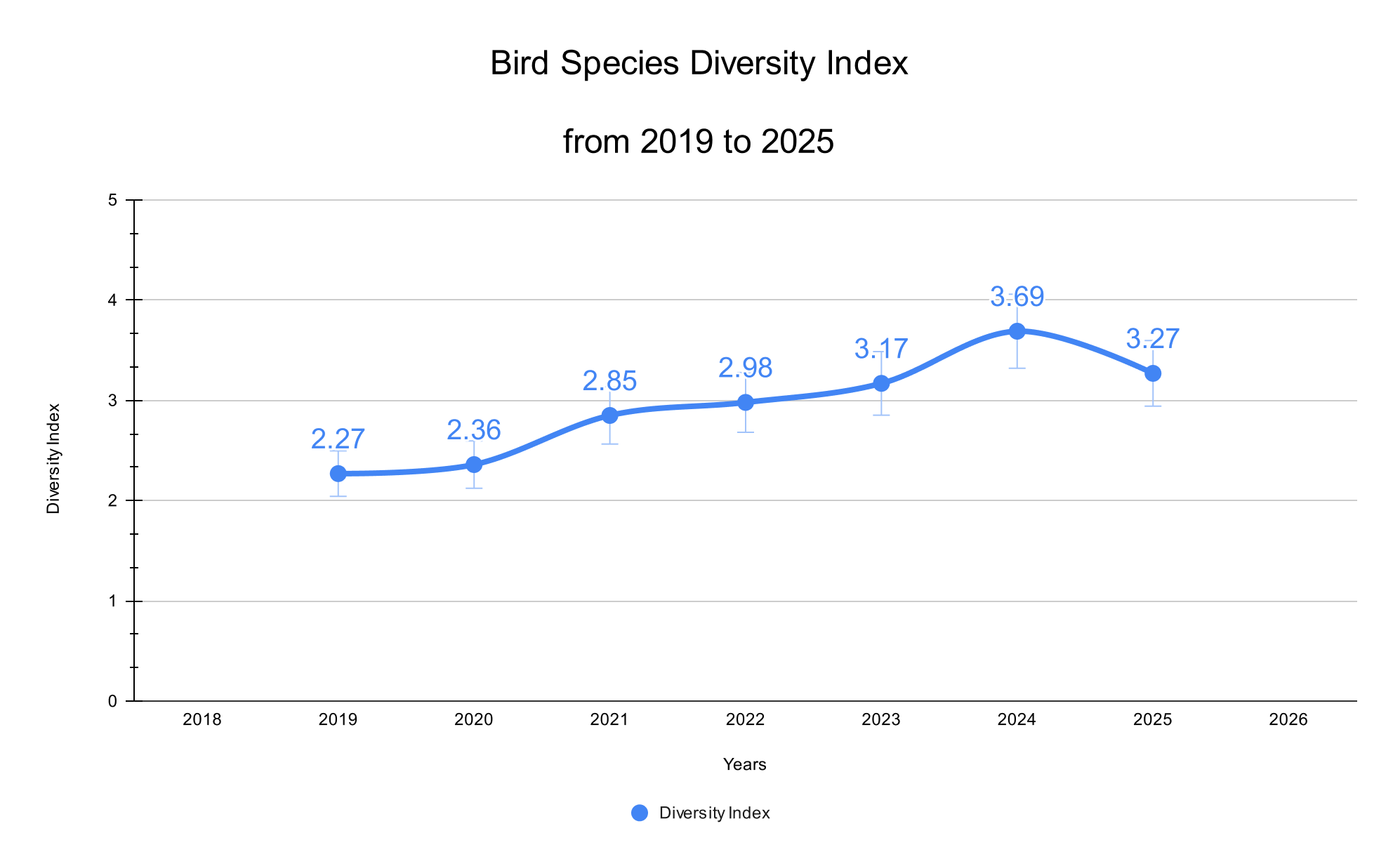
Figure. Bird Species Diversity Index in 2019–2025
The 2025 monitoring results recorded a total of five bird species categorized as protected under Government Regulation (PP) No. 7 of 1999. Meanwhile, based on Ministerial Regulation LHK No. P.106 of 2018, seven protected bird species were identified. Aside from birds, no mammal or herpetofauna species encountered during the survey fall under any protected category.
Table. List of Fauna Species Around BMC Classified as Protected and/or Listed in the CITES Appendices
| No | Scientific Name | Local Name | Common Name | PP No. 7/1999 | Ministerial Regulation LHK No. P.106/2018 | CITES |
|---|---|---|---|---|---|---|
| A. Birds | ||||||
| 1 | Spilornis cheela | Elang-Ular Bido | Crested Serpent-Eagle | Protected | Protected | Appendix II |
| 2 | Charadrius javanicus | Cerek Jawa | Javan Plover | – | Protected | – |
| 3 | Leptoptilus javanicus | Bangau Tong-Tong | Lesser Adjutant | Protected | Protected | – |
| 4 | Crypsirina temia | Tangkar Centrong | Racket-Tailed Treepie | – | Protected | – |
| 5 | Sterna hirundo | Dara-Laut Biasa | Common Tern | Protected | Protected | – |
| 6 | Chlidonias hybrida | Dara-Laut Kumis | Whiskered Tern | Protected | Protected | – |
| 7 | Thalasseus bergii | Dara-Laut Jambul | Great Crested Tern | Protected | Protected | – |
| 8 | Cinnyris jugularis | Burung-Madu Sriganti | Olive-Backed Sunbird | Protected | – | – |
| 9 | Thidpura javanica | Kipasán Belang | Sunda Pied Fantail | Protected | Protected | – |
| B. Herpetofauna | ||||||
| 1 | Malayopython reticulatus | Ular Sanca Kembang | Reticulated Python | – | – | Appendix II |
| 2 | Varanus salvator | Biawak Air | Asian Water Monitor | – | – | Appendix II |
Based on international trade status, a total of three (3) species—consisting of one bird species and two herpetofauna species—are listed under CITES Appendix II (data valid as of May 2024). According to the global threat status under the IUCN Redlist (version 2024-1), there is one bird species categorized as NT/Near Threatened, as well as 4 mammal species, 57 bird species, and 5 herpetofauna species categorized as LC/Least Concern (low risk). No species categorized as threatened with extinction were recorded.
Table. List of Fauna Species Around BMC Based on Rarity/Threat Status of the IUCN Redlist (Version 2025-1)
| No | Scientific Name | Species Name | Common Name | Redust IUCN |
|---|---|---|---|---|
| A. Mammals | ||||
| 1 | Callosciurus Notatus | Bajing Kelapa | Plantain Squirel | Least Concern |
| 2 | Cynopterus Sp. | Kelelawar | Bat | Least Concern |
| 3 | Herpestes Javanicus | Garangan Jawa | Javan Mongoose | Least Concern |
| 4 | Rattus Norvegicus | Tikus Got | Brown Rat | Least Concern |
| B. Birds | ||||
| 1 | Aegithina Tiphia | Cipoh Kacat | Common Lora | Least Concern |
| 2 | Alcedo Coerulescens | Raja-Udang Biru | Cerulean Lora | Least Concern |
| 3 | Amauromis Phoenicurus | Kareo Padi | Cerulean Kingfisher | Least Concern |
| 4 | Anas Gibberifona | Itik Benjut | Sunda Teal | Least Concern |
| 5 | Apus Nipalensis | Kapinis Rumah | House Swift | Least Concern |
| 6 | Apus Pacificus | Kapinis Laut | Pacific Swift | Least Concern |
| 7 | Ardea Alda | Kuntul Besar | Great White Egret | Least Concern |
| 8 | Ardea Intermedia | Kuntul Perak | Intermediate Egret | Least Concern |
| 9 | Ardeola Spciosa | Blekok Sawah | Javan Pond-Heron | Least Concern |
| 10 | Artamus Leucoryn | Kekep Babi | White-Breasted Woodswallow | Least Concern |
| 11 | Bubulcus Ibis | Kuntul Kerjbau | Wastern Cattle Egret | Least Concern |
| 12 | Butorides Striata | Kokokan Laut | Green-Backed Heron | Least Concern |
| 13 | Cacomantis Maerulinus | Wiwik Kelabu | Plaintive Cuckoo | Least Concern |
| 14 | Cacomantis Seputcralis | Wiwik Uncuing | Rusty-Breasted Cuckoo | Least Concern |
| 15 | Caprimulgus Affinis | Cabak Kota | Savanna Nightjar | Least Concern |
| 16 | Cecropis Daurica | Layang-Layang Loreng | Red-Rumped Swallow | Least Concern |
| 17 | Centropus Sinensis | Bubut Besar | Greater Goucal | Least Concern |
| 18 | Charadrius Javanicus | Cerek Jawa | Javan Plover' | Least Concern |
| 19 | Chlidonias Hybrida | Dara-Laut Kumis | Whiskered Tern | Least Concern |
| 20 | Cinnyris Jugularis | Burung-Madu Sriganti | Olive-Backed Sunbird | Least Concern |
| 21 | Cisticola Juncidis | Cici Padi | Zitting Cisticola | Least Concern |
| 22 | Collocalia Linchi | Walet Linci | Cave Swiflet | Least Concern |
| 23 | Crypsirina Temia | Tangkar Centrong | Racket-Tailed Treeple | Least Concern |
| 24 | Dicaeum Trigonostigma | Cabai Bunga-Api | Orange-Bellied Flowerpecker | Least Concern |
| 25 | Dicaeum Trochileum | Cabai Jawa | Scarlet-Headed Flowerpecker | Least Concern |
| 26 | Dicrurus Macrocercus | Srigunting Hitam | Black Drongo | Least Concern |
| 27 | Egretta Garzetta | Kuntul Keci | Little Egret | Least Concern |
| 28 | Geopelia Striata | Perkutut Jawa | Zebra Dove | Least Concern |
| 29 | Gerygone Sulphurea | Remetuk Laut | Golden-Bellied Gerygone | Least Concern |
| 30 | Hemiprocne Longipennis | Tepekong Jambul | Grey-Rumped Treeswift | Least Concern |
| 31 | HImantopus Leucocephalus | Gagang Bayam Timur | White-Headed Stilt | Least Concern |
| 32 | Hirundo Rustica | Layang-Layang Asia | Barn Swallow | Least Concern |
| 33 | HIrdundoTahitica | Layang-Layang Bafu | Tahiti Swallow | Least Concern |
| 34 | Lalage Nigra | Kapasan Kemiri | Pled Triller | Least Concern |
| 35 | Lalage Seurii | Kapasan Sayap Putih | White-Shouldered Triller | Least Concern |
| 36 | Leptoptilos Javanicus | Bangau Tong-Tong | Lesser Adjutant | Least Concern |
| 37 | Lonchura Leucogastroides | Bondol Jawa | Javan Munia | Least Concern |
| 38 | Lonchura Maja | Bondol Haji | White-Headed Munia | Least Concern |
| 39 | Lonchura Punctulata | Bondol Peking | Scaly-Breasted Munia | Least Concern |
| 40 | Merops Philippinus | Kirik-Kirik Laut | Blue-Taled Bee-Eater | Least Concern |
| 41 | Orthotomus Ruficeps | Cinenen Kelabu | Ashy Tailorbird | Least Concern |
| 42 | Orthotomus Sutorius | Cinenen Pisang | Common Tailorbird | Least Concern |
| 43 | Passer Montanus | Burung Gereja Erasia | Eurasian Tree Sparrow | Least Concern |
| 44 | Phalacrocorax Sulcirostris | Pecuk Padi Hitam | Little Black Cormorant | Least Concern |
| 45 | Picoides Moluccensis | Caladi Tilik | Sunda Pygmy-Woodpecker | Least Concern |
| 46 | Prinia Flaviventris | Perenjak Rawa | Yellow-Bellied Prinia | Least Concern |
| 47 | Prinia Inornata | Perenjak Padi | Plain Prinia | Least Concern |
| 48 | Pycnonotus Aurigaster | Cucak Kutilang | Sooty-Headed Bulbul | Least Concern |
| 49 | Pycnonotus Goiaveier | Merbah Cerukcuk | Yellow-Vented Bulbul | Least Concern |
| 50 | Pycnonotus Melanicterus | Cucak Kuning | Black-Capped Bulbul | Least Concern |
| 51 | Rhipidura Javanica | Kipasan Belang | Sunda Pied Fantail | Least Concern |
| 52 | Spilo[elia Chinensis | Tekukur Biasa | Eastern Spotted Dove | Least Concern |
| 53 | Spilornis Cheela | Elang-Ular Bido | Crested Serpent-Eagle | Least Concern |
| 54 | Stema Hirundo | Dara-Laut Biasa | Common Tern | Least Concern |
| 55 | Thalasseus Bergii | Dara-Laut Jambul | Great Crested Tern | Least Concern |
| 56 | Todirhamphus Chloris | Cekakak Sungai | Collared Kingfisher | Least Concern |
| 57 | Todirhamphus Sanctus | Cekakak Suci | Sacred Kingfisher | Least Concern |
| 58 | Turnix Suscitator | Gemak Loreng | Barred Buttonquail | Least Concern |
| C. Herpetofauna | ||||
| 1 | Cerberus Rynchops | Ular Tambak | Asian Bockadam | Least Concern |
| 2 | Eurtropis Multifasciata | Kadal Kebun | Common Sun Sink | Least Concern |
| 3 | Fejervanrya Cancrivora | Kodok Sawah | Rice-Field Frog | Least Concern |
| 4 | Malayopython Reticulatus | Ular Sanca Kembang | Reticulated Python | Least Concern |
| 5 | Varanus Salvator | Biawak Air | Asian Water Monitor | Least Concern |


Figure. Several Bird Species Recorded in the BMC Area and Its Surroundings During the 2025 Monitoring Period
Program Keberlanjutan

Monitoring & Evaluation
Observing the development and growth of the planted mangroves, as well as providing guidance and recommendations for area management.

Mangrove Planting
Mangrove planting is one of the efforts carried out to enhance biodiversity in the BMC area as well as to reduce the potential for coastal abrasion.


Mangrove Nursery
PGN SAKA plays an active role in supporting mangrove nursery activities at the Banyuurip Mangrove Center (BMC). The nursery has successfully propagated various mangrove species in large quantities. These seedlings are not only used to restore the mangrove condition in Banyuurip itself but also to provide ready-to-plant seedlings in substantial numbers to support mangrove rehabilitation efforts in other regions.


BMC Mangrove Ecotourism
The BMC area has been developed into a tourism zone based on a mangrove ecotourism concept. This initiative represents a potential economic opportunity—and even an alternative livelihood option—when properly managed.

Sharing Knowledge
Regular meetings with the local community are conducted by PGN SAKA regarding the management of the Banyuurip Mangrove Center and its surrounding areas.


ISBN Book Publication (2022, 2023, 2024)
The purpose of writing these books is to provide an overview of the mangrove ecosystem conditions at the Banyuurip Mangrove Center.